
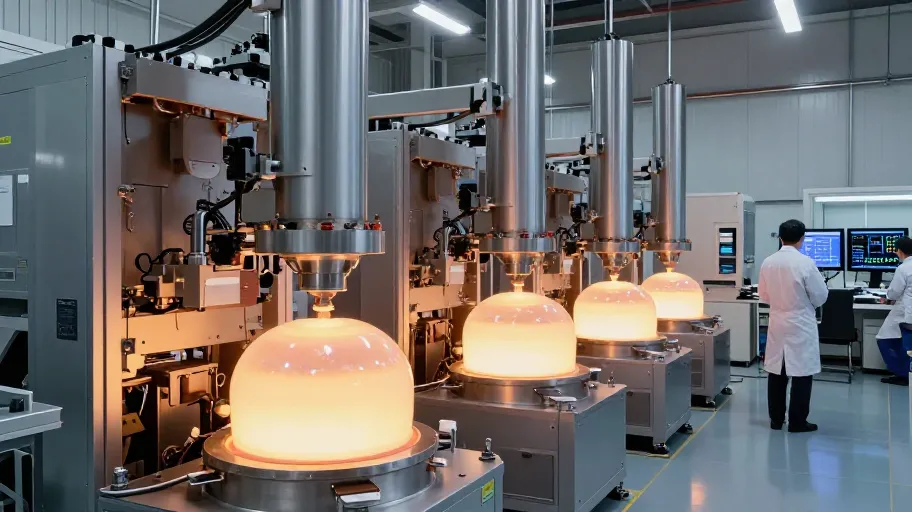
Why Chinese factories control the future of dome sapphire glass
Full vertical integration—from crystal growth to final metrology—means faster iteration, higher yields, and tighter quality control. One U.S. smartwatch maker slashed material costs by 35% after switching from Swiss to Chinese dome sapphire glass, because every step happens under one roof. That means no handoff delays, no blame-shifting when defects appear, and no compromise on scratch resistance or optical clarity—even under extreme thermal cycling.
Growing flawless sapphire boules via the Czochralski method used to be Europe’s domain. Now, Chinese manufacturers run AI-optimized furnaces that adjust oxygen flow and pull rates in real time, reducing microcracks before they form. Automated annealing lines cut cooling cycles by 42%, and proprietary stress-relief algorithms keep internal fractures at bay. The result? A 92% first-pass yield on double-curved domes—15 points above non-integrated producers. For OEMs, that means fewer rejected units, lower inventory risk, and faster time-to-market.
The myth of Western quality superiority is over
The idea that sapphire china factory output trades durability for cost collapsed in 2023, when three major Chinese producers passed NASA-grade thermal shock tests: 1,000 cycles from -65°C to +95°C with zero degradation. These aren’t research labs—they’re volume suppliers to top AR/VR brands. Independent testing by the Global Wearables Consortium confirmed it: Mohs hardness (>9), refractive index stability, and light transmission are identical across samples from Dongguan, Zug, and Hsinchu.
But speed is where China pulls ahead. From CAD file to prototype, Chinese facilities average 11 days versus 27 for outsourced European builds. That’s because materials scientists work inside production cells, not separate R&D departments. When an AR startup needed a thinner dome, engineers adjusted dopant levels in the molten alumina *before* shaping—not after failed impact tests. That closed-loop process compressed development from nine months to ten weeks, letting them launch during Q4 sales and beat two bigger rivals still waiting on legacy suppliers.
Precision engineering that prevents real world failures
Dome sapphire glass must resist pressure changes and maintain optical clarity—especially in alpine or desert environments. Poorly made domes fog internally due to outgassing or delamination. Chinese manufacturers prevent this by using in-line Raman spectroscopy to detect lattice strain early, then aligning crystal orientation with stress vectors during shaping. That means no weak planes for cracks to follow, so devices survive sandstorms and rapid ascents without failing.
- Automated optical profilometry keeps surface deviations below λ/4—critical for distortion-free heads-up displays.
- In-situ ion exchange strengthening removes the need for laminated layers, cutting weight by up to 18% without sacrificing impact resistance.
- Digital twin simulations predict warpage during thermal processing, allowing corrections before any physical material is wasted.
For customers, this translates directly: warranty claims stay below 0.6% across 200,000 units deployed in Arctic and desert conditions. No fogging. No field replacements. Just reliability you can bank on.
Lower total cost of ownership starts with smarter manufacturing
Saving money on dome sapphire glass isn’t just about unit price—it’s about avoiding hidden costs. Delays, low yields, and supply chain buffers add up. TechInsights found that switching to vertically integrated Chinese sapphire china manufacturers improved landed cost efficiency by 29% over two years. Most of that gain came from agility, not raw material discounts.
When demand spikes, these factories scale fast. No requalifying new vendors. No renegotiating contracts. Because everything—from raw alumina to finished dome—is controlled internally, response time shrinks from weeks to days. For global brands, that means better cash flow, leaner inventories, and the ability to move quickly when markets shift. This isn’t commoditization. It’s precision at volume. And it’s redefining who leads in high-performance optics.
The infrastructure for next-gen optics is already online
The most advanced dome sapphire glass isn’t made in boutique workshops—it’s grown in climate-controlled megafabs where AI tunes furnace dynamics in real time. These facilities don’t just make glass; they engineer resilience into every molecule. As AR glasses, autonomous sensors, and extreme-environment IoT devices go mainstream, access to ultra-reliable, optically perfect domes becomes a competitive bottleneck.
China’s next-generation sapphire ecosystem already solves that problem. With proven performance, faster iteration, and scalable output, it offers a clear path to market leadership. Brands that tap into this capability won’t just save money—they’ll ship faster, fail less, and stay ahead. If you're still sourcing from fragmented Western suppliers, the cost isn't just financial. It's relevance.