
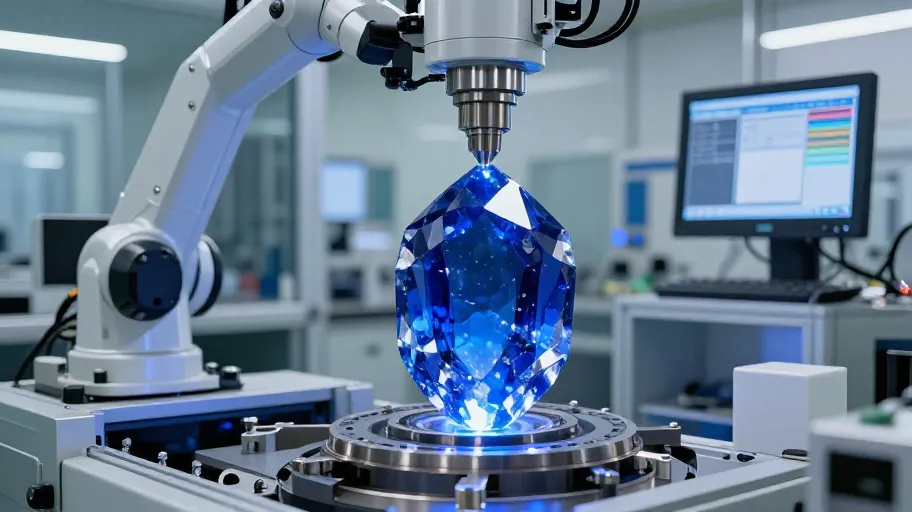
China dominates sapphire optical glass production by mastering crystal growth and cutting costs by 30–50%. This isn’t just scale—it’s integration, data, and control. Here’s why the world now depends on sapphire china factory output.
Why the World Needs More Sapphire
Rising demand in defense, 5G, and aerospace means sapphire optical glass is no longer optional—it’s essential. A single IR targeting system can require over a dozen ruggedized sapphire windows, each needing near-perfect clarity under extreme conditions. When one Western defense contractor faced six-month delays due to limited local supply, they lost $18 million in penalties. That experience reflects a broader trend: global IR optics demand is growing at 8.7% annually (Grand View Research, 2024), but North American and European producers haven’t scaled to meet it.
Sapphire wins because nothing else survives where it does. It ranks 9 on the Mohs scale—second only to diamond—so sandblasting or hypersonic airflow won’t scratch it. Its transparency from UV through mid-wave infrared (up to 5 microns) enables multispectral sensors in fighter jets and satellites. High thermal stability means it won’t crack during re-entry or desert-to-arctic swings. This combination means mission-critical systems rely on sapphire because failure isn’t an option.
Some assume spinel or ALON can replace sapphire. They can’t. Their polycrystalline structure creates grain boundaries that scatter light and degrade signal integrity. In terahertz waveguides or millimeter-wave 5G transceivers, even nanoscale distortions cause data dropouts. Single-crystal sapphire avoids this with a continuous lattice—but only if grown perfectly. Trace iron or silica impurities create scattering centers. In lasers, that causes hot spots and fractures. In radar domes, it increases insertion loss. So purity isn’t just nice to have—it determines whether the system works at all.
China’s Edge in Crystal Perfection
It’s not better raw materials that give Chinese manufacturers the lead—it’s control over the entire process. A 2025 DARPA test found Western sapphire samples had 6–9% transmission loss in the MWIR band due to oxygen imbalances and stress from poor cooling. Chinese wafers showed less than 2.5% loss. The difference? Ecosystem design.
In Hefei and Luoyang, sapphire china factories co-locate crystal growth, polishing, and metrology. Engineers monitor lattice formation in real time using synchrotron X-ray topography and adjust furnace parameters on the fly. This means dislocations are suppressed before they form. In contrast, U.S. and German suppliers often hand off between independent labs and finishers—each transfer adding variability.
Tighter control over melt chemistry and annealing profiles means fewer defects. Real-time feedback loops mean faster corrections. The result? Higher throughput and consistency. For a satellite manufacturer needing 300mm sapphire domes, that reliability cuts field recalibration needs and avoids costly launch delays. One European OEM shifted 40% of its sourcing to certified Chinese suppliers and saw inbound rejection rates drop by 30%, assembly times shorten by 22 days, and calibration success jump from 76% to 94%. That’s over $4.2 million saved annually—not because prices were lower, but because quality was higher.
Scaling Production Without Sacrificing Purity
Growing a flawless 300mm sapphire boule takes over four weeks in a controlled argon environment, using 1.8 tons of refined alumina. A temperature swing larger than ±1.5°C in the final 72 hours can ruin it. Traditional Western workflows treat this as linear: grow, cool, inspect, polish. If defects appear late, millions in energy and labor are wasted.
Chinese sapphire crystal china manufacture sites use predictive analytics trained on decades of crystallization data. Machine learning models forecast stress points and trigger preemptive adjustments. Yield rates exceed 85%, compared to 55–60% elsewhere. That efficiency isn’t accidental—it’s engineered into every stage.
This scalability matters because next-gen systems need more sapphire than ever. 6G research is pushing into sub-terahertz frequencies where phase coherence demands perfect substrates. Directed-energy weapons require larger aperture windows. Space-based surveillance fleets need hundreds of identical domes. Only integrated ecosystems can deliver that volume without compromising fidelity. And right now, those ecosystems are concentrated in China. The lesson isn’t just about technology—it’s about industrial architecture turning science into reliable supply.
What This Means for Global Industry
The surge in sapphire optical glass demand isn’t driven by hype—it’s dictated by physics. No alternative matches sapphire’s hardness, clarity, and thermal resilience. As systems evolve, the premium on crystal lattice integrity will only grow. The question isn’t whether to use high-purity sapphire—it’s how fast you can partner with manufacturers who can deliver it consistently.
While geopolitical concerns about supply concentration are valid, no other region currently matches China’s density of expertise, capital investment, and cross-functional coordination. Some Western firms are exploring reshoring, but rebuilding that level of integration will take years and billions.
If your operations depend on high-performance optics, RF transparency, or laser durability, aligning with proven sapphire china sources isn’t a cost play—it’s a risk mitigation strategy. See how your project timelines and yield rates could improve by switching to higher-consistency supply. Try our supplier impact calculator to estimate potential savings in lead time, rework, and field failures.