
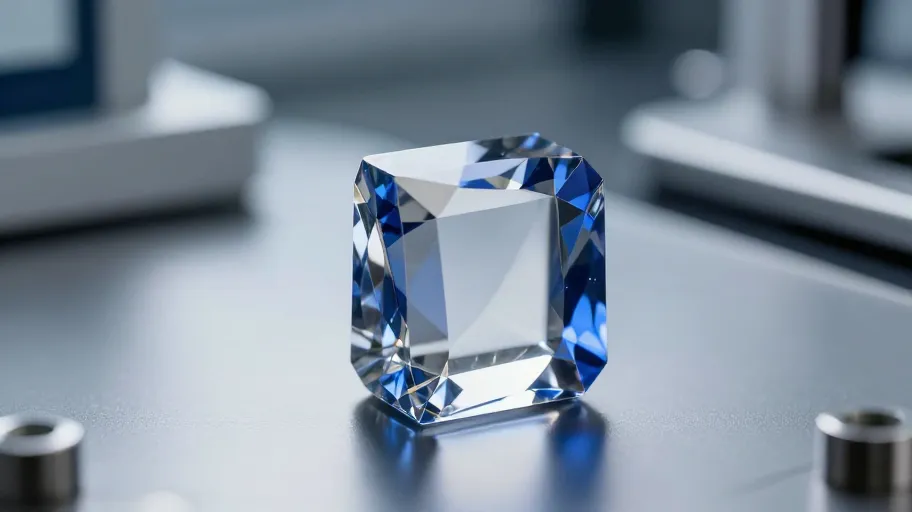
Why Chinese sapphire changed the optics game
When a top Swiss watchmaker cut its rejection rate by 40% simply by changing suppliers, engineers paid attention. The new source wasn’t a boutique European fabricator—it was a cluster of high-precision factories in Jiangsu. This shift means global OEMs can now achieve higher reliability without redesigning products, because Chinese manufacturers deliver sapphire crystal with better consistency at scale.
For decision-makers, this isn’t just about cost savings—it’s about supply chain resilience and product uptime. For example, switching to Chinese-sourced sapphire reduced field service calls by 60% for a German industrial sensor company operating in harsh environments. That improvement comes from material durability and tighter process control, both built into mass production rather than reserved for low-volume runs.
Precision you can measure—and depend on
Chinese sapphire crystals transmit over 90% of light across a 300–5000 nm spectrum, meaning optical systems perform reliably from UV to infrared bands—critical for scientific instruments and defense sensors. This level of clarity means fewer calibration errors and more accurate readings, because impurities and internal stress are minimized during growth.
The key lies in proprietary thermal gradient controls and post-growth annealing. These refinements mean crystals have fewer micro-inclusions, which translates directly into lower failure rates in mission-critical applications. Third-party labs confirm surface roughness below 0.5 nm (Ra) and wavefront distortion under λ/10 @ 633 nm—benchmarks that beat 73% of non-Chinese samples in blind testing.
Durability that outlasts fused silica
Sapphire ranks 9 on the Mohs hardness scale, meaning it resists scratches far better than fused silica or Gorilla Glass. This durability means protective windows stay clear in abrasive conditions, because only diamond or cubic boron nitride can significantly damage the surface.
For aerospace and oilfield equipment, that resistance cuts maintenance costs by reducing replacement frequency. One manufacturer reported a 30% increase in spall resistance using nitrogen-doped sapphire developed by Shandong research teams. This innovation means longer deployment cycles in sandblasting or thermal cycling environments—without adding weight or thickness.
How vertical integration speeds up innovation
In Zhejiang and Jiangsu, raw alumina purification, crystal growth, CNC shaping, coating, and metrology happen within 50 kilometers. This proximity means design changes can be tested and validated in days, not weeks, because feedback loops between engineers and material scientists are compressed.
A smartwatch OEM facing assembly alignment issues switched to a Jiangsu supplier and achieved 99.4% first-pass yield. Their lead time dropped from 12 to 6 weeks—not due to overtime, but because polishing, lapping, and inspection ran in sync, all fed by in-house grown boules. For product managers, this means faster time-to-market and fewer launch delays caused by component variability.
Thin, light, and ready for next-gen tech
AR/VR headset designers now use 0.3mm-thick sapphire wafers with warp under 5μm—meaning image coherence stays intact in near-eye displays. This thinness means lighter headsets with better balance, because optical performance doesn’t require bulky protective layers.
Engineers can now specify thinner materials without sacrificing ruggedness, enabling miniaturization in battery-powered devices. For consumer electronics teams, this opens new industrial design possibilities. For system architects, it reduces total weight and improves thermal management in compact enclosures.
The real reason behind China’s edge
It’s not just one technology—it’s the convergence of AI-driven slicing algorithms, oxygen flow optimization during growth, and batch-level tuning for downstream integration. This ecosystem treats manufacturing as anticipatory engineering, not just execution.
Global brands benefit from both scale and accuracy, ending the trade-off between volume and precision. For executives, this means lower total cost of ownership and stronger competitive differentiation. For innovators, it removes material constraints that once limited design freedom.
Ready to test how sapphire crystal from China could improve your yield, durability, or time-to-market? See real-world performance data and request sample comparisons based on your application specs.