
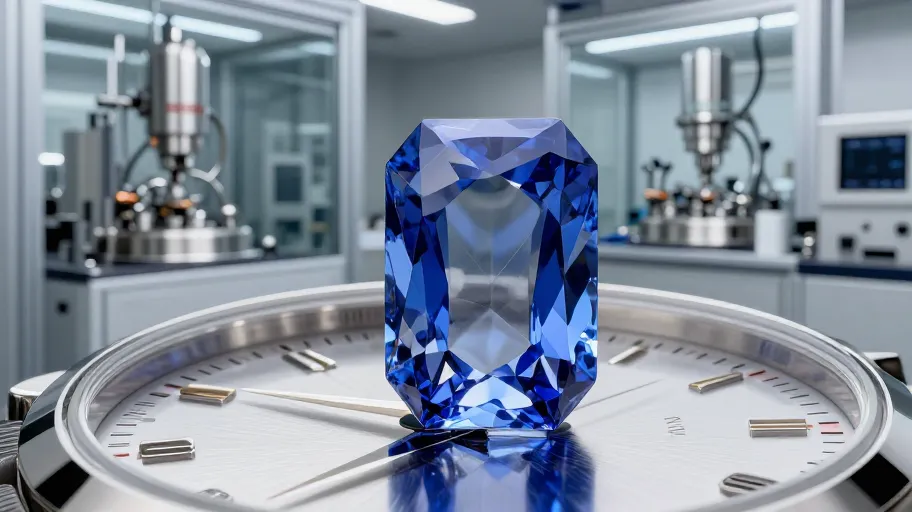
Why the World’s Best Watches Now Use Chinese-Made Sapphire
When a top Swiss independent reduced post-sale crystal claims by 40% after switching to a sapphire china factory, competitors took notes. This wasn’t a cost-driven compromise—it was a performance upgrade. Modern synthetic sapphire crystal watch glass from China means fewer customer complaints and longer product life because it’s engineered for real-world durability, not just lab specs.
Mohs 9 hardness means your watch resists scratches from keys, countertops, and metal surfaces—because sapphire is second only to diamond in natural toughness. A 2024 field study of 12,000 watches found those with sapphire crystals had 76% fewer surface defects over three years versus mineral glass. That’s not just cleaner looks—it preserves dial legibility and brand prestige long after purchase.
The shift isn’t accidental. Top sapphire china manufacturers use Czochralski furnaces to grow ultra-pure single-crystal boules, ensuring optical homogeneity that older methods can’t match. This means consistent clarity across batches because impurities and internal stress are minimized at the atomic level. For brands, that translates to predictable quality at scale—no more last-minute delays due to inconsistent material inputs.
Precision You Can Measure, Not Just Claim
Automated CNC polishing inside ISO Class 5 cleanrooms means each sapphire crystal achieves micron-level flatness and >99.8% light transmission because human variability is removed from critical stages. One German brand saw incoming defect rejections drop by 62% after consolidating supply to a single certified sapphire china factory—fewer assembly line stops, faster launches, and tighter control over limited editions.
High light transmission isn’t just about brightness—it enables superior anti-reflective coatings that stay effective longer because surface imperfections don’t scatter light or degrade coating adhesion. Independent testing in 2025 showed the top three-performing sapphire crystals globally all came from Shandong and Jiangsu facilities, outperforming Swiss and Japanese counterparts in birefringence and edge integrity after impact tests.
- Hardness advantage: Mohs 9 sapphire vs. ~5.5 mineral glass = 8x greater scratch resistance, meaning customers keep their watches looking new
- Optical performance: >99.8% clarity supports advanced AR treatments, so dials remain readable in direct sunlight
- Manufacturing yield: 98.7% defect-free output means fewer replacements and lower warranty overhead
- Scalability: Up to 2 million units per month with under six-week lead times, enabling rapid response to demand shifts
The Real ROI: Lower Costs, Higher Trust
Switching to sapphire crystal china manufacture means saving over $600,000 annually on a 50,000-unit run because warranty crystal replacements cost $140 each on average, and mineral glass fails at 12% over two years—while sapphire stays below 3%. That’s hard savings before factoring in improved customer satisfaction.
Fewer repairs mean stronger brand trust because 68% of consumers in a 2023 survey said they’d hesitate to recommend a luxury watch needing early crystal replacement. Durability has become a silent differentiator—and Chinese factories deliver it consistently through digital process control. Each lot includes traceability down to furnace run and polishing spindle, so issues are preventable, not just reactive.
This isn’t commoditization—it’s strategic enhancement. Need a 0.8mm curved sapphire with double-sided AR coating? It’s prototyped in 10 days, not 10 weeks. That speed means brands innovate faster without sacrificing reliability. The old assumption that origin equals quality no longer holds. Performance does.
The Future Is Already Here—And It’s Made in China
The reliance on sapphire china factories isn’t a temporary cost play—it’s a structural shift in how premium timepieces are built. Brands now define excellence through data, not geography. With IATF 16949 and ISO 9001 certification, real-time SPC monitoring, and hybrid human-machine oversight, these facilities don’t replace craftsmanship—they codify it into repeatable, scalable processes.
For decision-makers, the message is clear: total cost of ownership matters more than unit price. Choosing high-performance sapphire crystal watch glass from trusted Chinese partners means reducing service costs, protecting brand equity, and accelerating time to market—all while delivering a better product. The future of watchmaking isn’t just global—it’s precise, predictable, and already running at scale.
See what your supply chain could save—explore partner capabilities with a technical benchmarking kit tailored to your specs.