
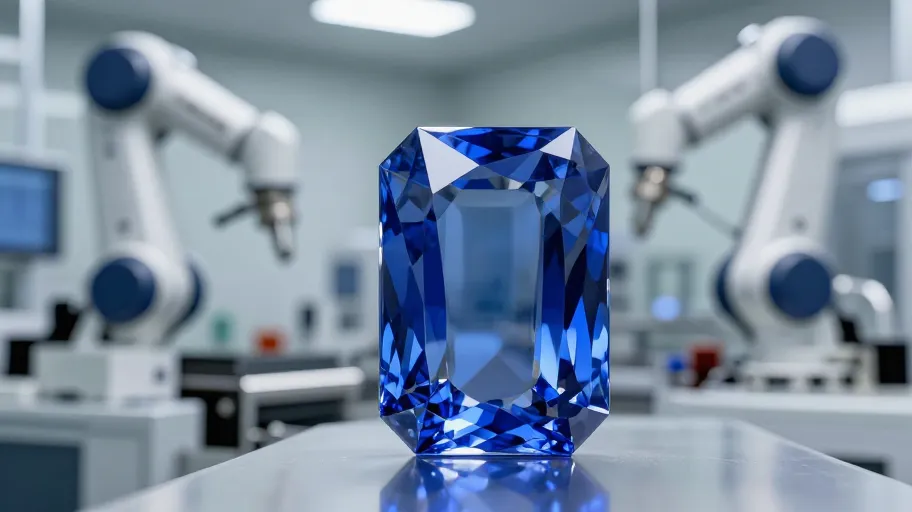
Why watch brands are switching to Chinese sapphire
High-end watchmakers aren’t chasing low costs—they’re chasing capability. Today, a tier-1 sapphire crystal china manufacture can deliver 15,000 custom domed sapphire crystals in 12 weeks with MOQs as low as 3,000 units. That means smaller brands can launch limited editions without overstocking, because flexibility scales with demand. European suppliers often require double the volume and take twice as long, making them a poor fit for agile product cycles.
This shift isn’t theoretical. One Swiss brand reduced time-to-market by 37% after shifting 60% of its sapphire sourcing to Kunshan. That speed means they now align new releases with fashion seasons in Asia and the Middle East—something previously impossible due to lead times. The real benefit? Getting to market ahead of competitors without sacrificing quality.
The precision gap no one talks about
Chinese sapphire factories now achieve 92% yield on complex domed blanks—14 points higher than European counterparts. That means fewer defects, less waste, and more predictable inventory, because high yield reduces supply chain volatility. It’s not luck; it’s engineering. CNC polishing takes 18 minutes per unit versus 34 minutes in EU plants, because robotic automation adjusts tool paths in real time using live metrology feedback.
Each workstation logs thermal expansion, surface roughness, and chipping risk, feeding data into a central system that fine-tunes downstream steps. That integration means sub-micron flatness isn’t an exception—it’s standard. In blind tests, experts couldn’t distinguish between Swiss and Chinese crystals based on clarity or distortion. One even noted lower Newton ring interference in the Chinese sample, because stress during annealing is better controlled.
Cost savings come from efficiency, not labor
The 28% lower unit cost from Chinese suppliers doesn’t come from cheap workers—it comes from vertical integration and smart automation. Boules are grown with proprietary dopants to reduce internal stress, then fed directly into multi-axis CNC clusters using diamond tools calibrated to ±0.5μm. That seamless flow from raw material to finished piece cuts handling errors and rework rates to under 1.2%, because AI-driven inspection flags issues before they compound.
For global brands, this means better margins without cutting corners. A German supplier might quote flawless specs—but at a price that forces higher retail markups or lower volumes. Chinese factories deliver the same Mohs 9 hardness and Grade A+ optical clarity at scale, so brands can offer competitive pricing while maintaining luxury positioning. The advantage isn’t just financial—it’s strategic.
Innovation moves faster in Kunshan
Need a 1.6mm ultra-thin sapphire with a curved open-heart cutout? European vendors charge premiums and take weeks to prototype. Top sapphire china factories deliver design iterations in 72 hours at no extra cost, because their systems are built for rapid iteration. That agility lets brands test bold designs—like bezelless profiles or recycled substrates—without financial risk.
One Geneva boutique wanted to use 30% post-consumer recycled sapphire. Their local supplier couldn’t do it. Their Chinese partner had already invested in laser deconstruction of returned crystals and delivered certified material in three months. That kind of forward-looking infrastructure isn’t rare—it’s standard among leading sapphire china factory operations, where continuous improvement drives daily KPIs.
The future is made in China, even if labeled Swiss
The next frontier isn’t just clearer glass—it’s smarter. Leading Chinese manufacturers are integrating anti-reflective coatings with tighter spectral control, developing embedded NFC tags in sapphire layers, and advancing sustainable processing like closed-loop water recycling. These innovations mean future watches won’t just look better—they’ll connect and last longer.
For global brands, the question isn’t whether to work with Chinese sapphire producers. It’s how fast they can build trusted partnerships. The factories mastering this shift aren’t just suppliers—they’re co-engineers of the next generation of luxury timepieces. And they’re setting the pace everyone else must follow.