
Demand is surging but old suppliers can’t keep up
Global orders for sapphire thermal monoculars have jumped 250% in five years. Defense programs, industrial sensors, and autonomous drones all need durable, optically perfect sapphire windows—fast. But legacy suppliers in Europe and North America still rely on the Verneuil process, a century-old method that limits crystal quality.
Poor crystalline structure means more internal stress and distortion. That translates to less than 65% usable output per batch. Over a third of every run gets scrapped. For procurement teams, this means lead times of 12–16 weeks and contracts locked in 14 months ahead. One aerospace subcontractor called it 'buying risk.'
High rejection rates mean higher unit costs and delayed deployments. Every extra week in lead time defers millions in revenue. The bottleneck isn’t just technical—it’s strategic.
China rewrote the rules with Kyro and HEM
Chinese manufacturers in Anhui and Jiangsu provinces shifted to advanced growth methods: Kyropoulos (Kyro) and Heat Exchanger Method (HEM). These aren’t tweaks—they’re full rewrites of the physics behind sapphire production.
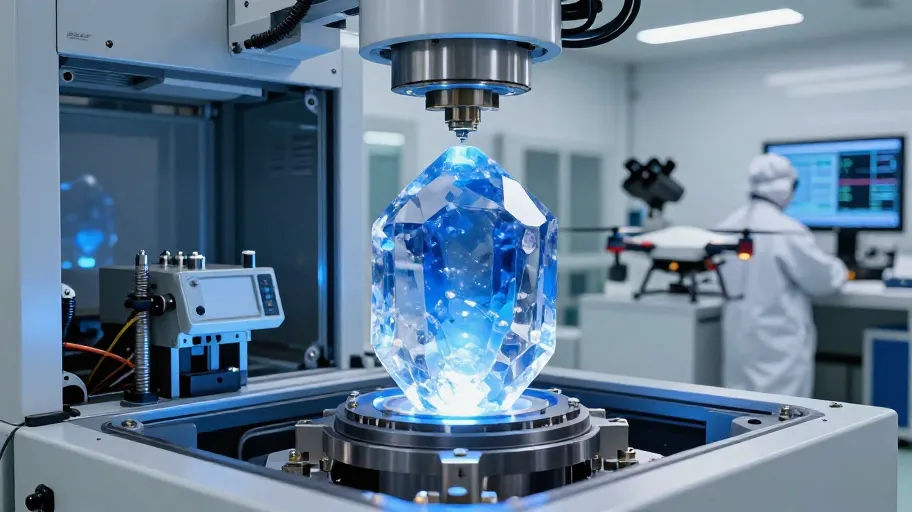
Kyropoulos pulls large-diameter ingots (up to 300mm) slowly from molten alumina under precise thermal control. This delivers near-perfect crystal alignment. HEM improves further by minimizing thermal shock during solidification, reducing dislocation density. The result? Batch yields above 88%—over 20 points better than Western averages.
Higher yield means lower cost per unit and more consistent optical performance. It also cuts lead times to 6–8 weeks. Predictable delivery lets defense and industrial firms respond faster to changing demands. Consistency isn’t a bonus—it’s built into the process.
Precision is now standard, not rare
Modern Chinese sapphire factories meet ISO 13356 standards for optical transmission, wavefront distortion, and birefringence—not as goals, but as routine outputs. Real-time interferometry and AI-driven annealing schedules maintain sub-micron tolerances across thousands of units.
One facility in Wuhu reported an average wavefront error of λ/10 across 95% of its recent production. That level of precision used to be limited to research labs. Now it’s shipping in volume.
This matters because thermal monoculars operate in extreme conditions—desert heat, arctic cold, high vibration. Any optical flaw distorts readings or reduces lifespan. Flawless sapphire means clearer imaging, longer field life, and fewer failures. For drone operators or frontline units, that’s mission-critical reliability.
Vertical integration kills supply chain waste
Chinese sapphire china factory clusters don’t just grow crystals—they handle slicing, lapping, polishing, and coating in-house. No shipping blanks between vendors. No mismatched specs. No blame games when coatings fail due to subsurface damage from poor sawing.
Each stage feeds data into the next. Diamond-wire tension adjusts based on real-time feedback. Polishing slurry pH is optimized per batch. This closed-loop system reduces defects and accelerates iteration.
The benefit? Fewer delays, lower inventory costs, and tighter quality control. A European drone OEM switched half its supply to a Jiangsu-based producer in 2023. Within nine months, lens failure rates dropped 40%, and carrying costs fell 22%. They regained agility to bid on sudden contracts—a capability their old supplier couldn’t offer.
The future belongs to those who control the chain
Legacy suppliers treat sapphire as a constrained commodity. Chinese leaders treat it as a programmable platform shaped by data, policy, and integration. As edge computing and robotics drive wider use of thermal vision, the gap will widen.
Mastery of sapphire isn’t about furnaces—it’s about owning the entire value chain. Right now, that control sits in China’s integrated manufacturing hubs. If your current supplier can’t guarantee performance and availability two years out, you’re already accumulating risk.
The shift is clear: scale plus science beats tradition. And for anyone deploying thermal monoculars, the question isn’t whether to adapt—it’s how fast you can move.