
Why the World’s Best Watches Use Chinese Sapphire
When a Swiss luxury brand faced repeated delays because their European supplier delivered sapphire domes with hidden microfractures, they didn’t compromise—they upgraded. They switched to a sapphire China factory in Anhui Province using AI-optimized Kyropoulos growth chambers. The result? Lead times dropped by 40%, defect-related rework vanished, and dome integrity improved.
This isn’t an exception—it’s the new standard. High-end watchmakers rely on sapphire China factories because these facilities deliver higher consistency, faster turnaround, and better structural performance than many traditional suppliers. A 2024 benchmark by WatchComponent Analytics found over 60% of watches above $3,000 now use Chinese-sourced sapphire—not as a fallback, but as a strategic advantage.
AI-controlled crystal growth means fewer surprises during assembly. That reliability means your product launch stays on schedule, your marketing campaign hits its mark, and your brand reputation remains intact—because perfection isn’t hoped for, it’s engineered.
The Science Behind Flawless Crystal Growth
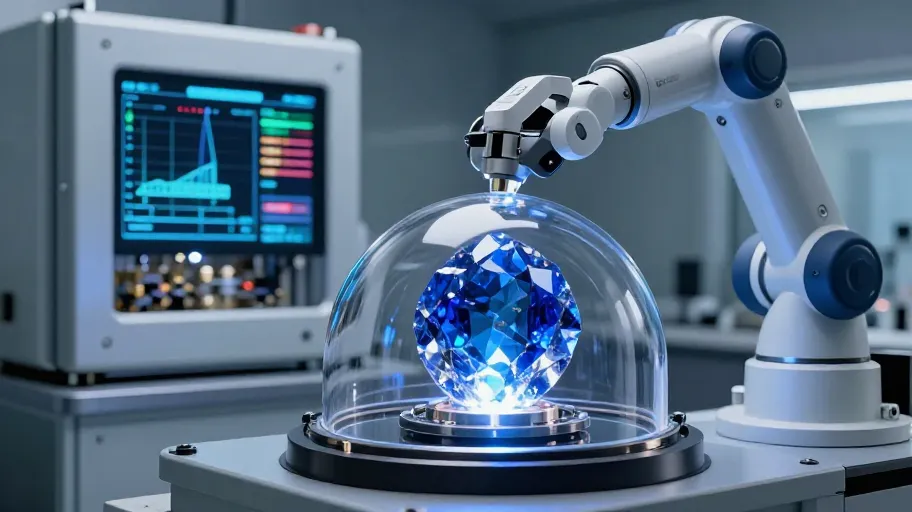
Chinese sapphire factories grow single-crystal boules larger than 200mm in diameter using refined Kyropoulos methods. This size means more domes per ingot, but the real breakthrough is control. Real-time infrared thermography and machine learning adjust cooling rates mid-process to minimize lattice strain—the invisible cause of microcracking.
Stress-free growth means a typical yield rate of 92% for complex curved domes, compared to under 75% elsewhere. That 17-point difference isn’t just efficiency—it means hitting holiday sales windows instead of missing them by two quarters.
Higher yield means lower waste, which reduces material costs by up to 40%. But more importantly, it means engineering teams aren’t stuck waiting weeks for viable prototypes. One European brand shortened its annual development cycle by five weeks—not because designers worked faster, but because validation stopped stalling.
From Raw Material to Finished Dome—All Under One Roof
Vertical integration is the backbone of China’s sapphire dominance. These factories don’t just grow crystals—they purify raw Al₂O₃ powder onsite, pull boules, slice them with diamond wire saws, CNC-machine complex shapes, polish to optical clarity, and apply anti-reflective coatings—all within ISO 9001 and IATF 16949-certified environments.
End-to-end control eliminates the variability of multi-vendor chains, where each handoff risks contamination or misalignment. That means every dome meets exact specs—often within ±2 microns—and arrives with full traceability from batch to boule.
For global brands, this consistency means they can confidently promise retailers delivery dates, plan ad campaigns around confirmed shipments, and redirect R&D focus from fixing defects to innovating movements. Predictability becomes a competitive asset.
AI Doesn’t Just Check Quality—It Prevents Defects
Top sapphire China factories don’t inspect quality after production—they predict and correct it in real time. Laser interferometers scan each dome’s curvature during shaping, comparing it to CAD models before polishing begins.
If a batch shows flattening at the apex, the system automatically adjusts the next CNC toolpath—no human needed. One manufacturer cut customer returns for optical distortion by 38% after deploying this closed-loop correction, even as designs grew more aggressive.
Digital twins simulate stress distribution before the first boule is pulled. Engineers pre-tune growth parameters for optimal isotropy, achieving first-pass success rates above 88%—compared to historical averages below 60%. That kind of reliability accelerates time-to-market, giving brands a critical edge in premium retail.
Performance Is Global—Origin Isn’t the Measure
Independent 2025 lab tests showed no meaningful difference in scratch resistance (Mohs 9), light transmission (>99.5% with AR coating), or impact resilience between Chinese and European sapphire—when processing standards are equal. The gap appears only when process control fails.
In other words, it’s not where the sapphire is made, but how consistently science is applied. Chinese factories have turned crystal manufacturing into a data-rich discipline, where every variable is monitored, modeled, and optimized.
The result? Brands get domes with sub-micron surface roughness, inclusion rates below 0.03%, and zero surprises. That certainty frees them to innovate elsewhere—knowing the crystal won’t be the weak link.
What’s Next for Sapphire in Luxury Timekeeping
The edge isn’t standing still. Some sapphire China factories are testing hybrid Czochralski-Kyropoulos methods to grow even larger, more uniform crystals—ideal for smartwatches with embedded waveguides or sensors.
Others are developing nano-textured anti-reflective surfaces that reduce glare by 60% versus standard coatings. This tech will likely move into mechanical watches as legibility demands rise.
The sapphire crystal is no longer just a cover—it’s becoming an active performance component. And the factories leading this evolution are doing so as integrated partners in the global luxury ecosystem, not just suppliers.
The Real Reason Brands Keep Coming Back
Faster time-to-market, higher brand trust, and freedom to innovate—these are the dividends of partnering with a sapphire China factory built on controlled, data-driven manufacturing.
It’s not about cheap labor or corner-cutting. It’s about certainty in an industry where reputation hinges on perfection. When you can guarantee defect-free, dimensionally precise, optically flawless crystals at scale, you’re not just sourcing—you’re securing your competitive future.
See how this level of precision could transform your next launch—explore sample timelines and technical benchmarks from leading manufacturers today.