
The Secret Isn’t Cheap Labor—It’s Full Control
Chinese manufacturers don’t win by cutting corners. They win by owning the entire process—from raw alumina powder to flight-ready sapphire window. That means no handoffs between crystal growers, polishers, and coaters in different countries. One facility handles everything. This vertical integration means you get consistent boule purity because oxygen levels and dopants are monitored in real time during growth. For your IR sensors, that translates into stable transmission across 3–5 µm wavelengths—so field calibration drops by up to 60%. Fewer tune-ups mean longer uptime, especially in remote or combat zones.
We worked with a U.S. defense integrator who switched to a fully traceable sapphire china factory. Their post-installation performance drift fell 40%. That’s not just reliability—it cut six weeks off deployment timelines per batch. When every day counts, that’s strategic leverage.
Custom Shapes Without the Custom Delays
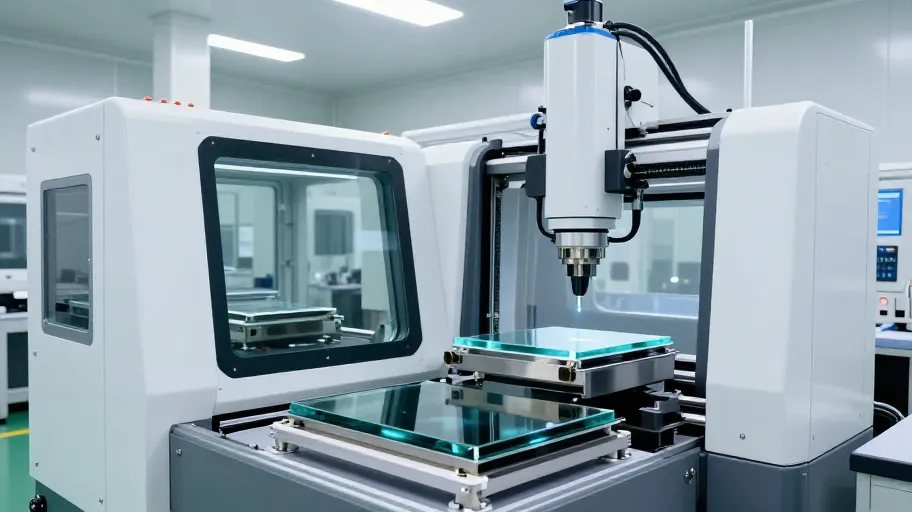
Need a beveled edge for tight LiDAR housing? A wedge angle to kill back-reflection in rangefinders? Chinese fabs treat complex geometries as standard—not exceptions. Multi-axis CNC machines use adaptive algorithms trained on millions of past cycles to grind and polish with ±0.1° angular accuracy and sub-micron parallelism. The result? Yield rates above 95% even on Class 1 surface finishes (MIL-PRF-13830B), which is better than many Western shops achieve on flat windows.
This isn’t inspection after the fact—it’s predictive correction. Interferometers scan surfaces between polishing stages and feed deviation maps back into robotic lapping routines. Machines adjust pressure, slurry mix, and dwell time on the fly. So fewer parts fail, scrap drops, and SPC bands tighten. For you, that means lower unit costs and more predictable delivery schedules—even at volumes over 50,000 units per quarter.
AI Doesn’t Replace Quality—It Enforces It
Human inspectors can miss subtle scratches or haze. AI doesn’t. In top sapphire china factories, machine vision systems grade surface quality objectively—no subjective calls. Automated handling also slashes contamination risks, which is critical when applying anti-reflective coatings in ISO Class 5 cleanrooms.
Digital twins let engineers simulate performance before cutting a single wafer. One European medical OEM needed 10,000 dual-wavelength AR-coated sapphire windows (532nm and 1064nm) for ophthalmic lasers. A Chinese partner delivered the first batch in eight weeks—zero rework—and scaled to 50,000 quarterly within six months. Their coating chambers used ML models tuned to humidity, particle count, and temperature drift. Coating adhesion stayed consistent across runs. That meant faster FDA validation and earlier market entry—giving them first-mover advantage in a crowded space.
Higher Upfront Cost, Much Lower Long-Term Risk
Sapphire windows cost more upfront than polycrystalline alternatives like spinel. But total cost of ownership over five years? Up to 35% lower. Why? Because consistent quality slashes scrap and rework. One aerospace supplier saw field returns due to coating delamination drop from 6.2% to 0.9% after switching to an integrated Chinese supplier. For satellite comms terminals using multiple sapphire RF domes, that meant less downtime and $4.2 million saved annually on one program line alone.
Scaling doesn’t dilute precision—it amplifies predictability. When automation replaces variability, high volume becomes the engine of consistency. And that changes the game for mission-critical systems where failure isn’t an option.
What Comes Next Changes Everything
The future isn’t just clearer windows—it’s smarter ones. Chinese manufacturers are already testing hybrid growth chambers that dope sapphire with rare-earth elements for tunable emissivity. Others are using femtosecond lasers to texture self-cleaning surfaces. These aren’t lab curiosities. Pilot lines are running now for automotive and defense clients.
If you still think of sapphire china as ‘cheap replication,’ you’re missing a shift. Scale, customization, and uncompromised quality now converge in ways that redefine what optical engineering can do. The companies winning tomorrow’s sensor wars aren’t just buying components—they’re partnering with manufacturers who build certainty into every micron.