
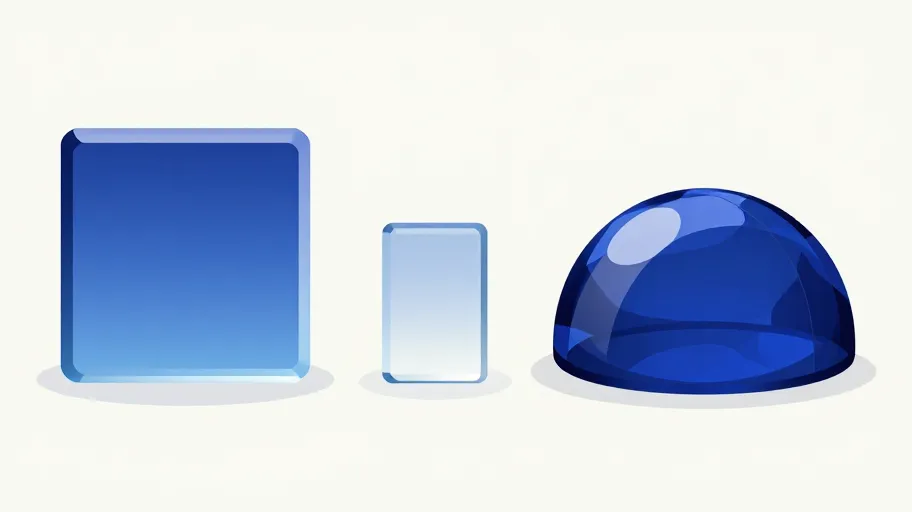
Selecting the correct sapphire watch glass types is a foundational decision that balances aesthetic intent against engineering constraints. For watch designers and private-label brands, the choice between flat, box-type, and domed geometries determines not only the visual identity of the timepiece but also the complexity of the supply chain. Flat profiles offer maximum structural efficiency and coating simplicity; box-type crystals provide vintage dimensionality without the extreme edge-thinning of domes; domed sapphires deliver superior visual depth and scratch-resistance angles but require careful thickness verification to maintain water resistance. The optimal choice depends on aligning the geometry with the specific utility and design language of the collection.
The Geometry-Utility Alignment Matrix
To streamline the selection process for OEM buyers, we utilize the Geometry-Utility Alignment Matrix. This framework moves beyond mere appearance and evaluates the crystal based on three primary vectors: Visual Priority (Depth vs. Clarity), Case Architecture (Height vs. Diameter), and Durability Requirements (Impact vs. Abrasion).
When applying this matrix, designers must first define the "visual priority." If the goal is legibility and a stark, modernist profile, the flat crystal is the logical utility choice. If the goal is a vintage revival or a dress watch with neo-classical proportions, the box-type is the superior alignment. If the objective is a sporty, high-end tool watch appearance, the dome provides the necessary visual hierarchy. However, utility also dictates that as the curvature increases, the center thickness must often increase to maintain integrity, which alters the case height requirements. Understanding these trade-offs early prevents redesigns later in the prototyping phase.
Flat Sapphire: The Standard of Precision
Flat sapphire glass remains the industry benchmark for divers, field watches, and contemporary minimalist designs. From a sourcing perspective, flat crystals represent the most efficient utilization of raw sapphire material and the most straightforward machining process.
Engineering Advantages: The primary advantage of flat geometry is the uniform distribution of thickness. Unlike domed variants where the center is significantly thicker than the edges, a flat crystal maintains consistent dimensions. This uniformity simplifies the engineering of the case back and gasket system. For diving watches, a flat crystal can be supported more rigidly against extreme water pressure, reducing the risk of flex at depth.
Sourcing Considerations: When procuring flat glass, the focus should shift to surface finish and optical coating. Because the flat surface presents a direct perpendicular angle to light sources, glare can be a significant issue for the end-user. Buyers should verify the supplier’s capability to apply double-sided anti-reflective (AR) coatings. Furthermore, because the edges are typically vertical, the interface between the crystal and the bezel is a critical sealing point. Designers should confirm the chamfer or bevel specifications to ensure the crystal sits flush without stressing the glass during installation.
Box-Type Sapphire: Dimensional Stability
Box-type sapphire occupies a unique middle ground between flat glass and full domes. Characterized by a flat central surface that drops vertically to the edges before meeting a distinct radius or bevel, the box-style mimics the acrylic crystals of mid-century tool watches while retaining sapphire’s hardness.
Engineering Advantages: The "box" geometry offers the aesthetic benefit of a tall, distortion-free side wall without the extreme center thickness of a high-dome crystal. This allows designers to create a vintage profile with a prominent glass bubble that maintains excellent legibility. The vertical sides also allow for a larger sealing surface area compared to a slanted dome, potentially aiding water resistance designs.
Sourcing Considerations: The complexity in manufacturing box-type crystals lies in the transition point between the flat surface and the vertical drop. This is a stress concentration point. Buyers should discuss the radius at the corners with their manufacturer. A sharper internal corner increases the risk of fracture during machining or later impact. A robust project specification will define the minimum internal radius required to mitigate structural failure. Additionally, ensure that the vertical height of the "box" wall is compatible with the movement height and dial spacing to avoid interference with the watch hands.
Domed Sapphire: Visual Depth and Refraction
Domed sapphire is the hallmark of luxury sports watches and heritage reissues. It increases the perceived visual depth of the dial, creating a magnifying effect that can enhance the readability of indices or date windows. However, it introduces the most significant engineering challenges of the three geometries.
Engineering Advantages: A dome offers superior impact resistance against direct blunt force because the curved shape disperses energy laterally. From an aesthetic standpoint, the dome allows for a smoother transition between the crystal and the case, eliminating the sharp shoulder found on flat crystals. This creates a more fluid, organic wrist presence. Furthermore, the angle of incidence changes across the surface of a dome, which can naturally mitigate glare in certain lighting conditions without fully relying on coatings.
Sourcing Considerations: The critical variable for domed crystals is the "edge thinning." As the sapphire is ground into a dome, the outer edges become naturally thinner. If the dome is too high relative to its diameter, the edges can become wafer-thin, making them susceptible to chipping during assembly or upon impact.
Buyers must strictly define the Center Thickness (CT) and Edge Thickness (ET) in their technical drawings. It is not sufficient to simply specify a "height" (the amount of rise above the case). You must ask the supplier: What is the minimum edge thickness achievable at this specific height and diameter? If the edge thickness falls below a safe threshold, the design must be adjusted—either by reducing the dome height or increasing the overall crystal thickness.
Decision Table: Selecting the Right Profile
To assist your product development team, the following table outlines the comparative trade-offs of each geometry type. Use this as a reference guide during the design review phase.
| Feature | Flat Sapphire | Box-Type Sapphire | Domed Sapphire |
|---|---|---|---|
| Visual Priority | Modern, utilitarian, high legibility | Vintage, dimensional, distinct edges | Luxury, depth, fluid continuity |
| Thickness Uniformity | High (Consistent center to edge) | Medium (Thick center/edge, vertical drop) | Low (Thick center, thin edges) |
| Impact Resistance | Good (Rigid support) | Variable (Depends on corner radius) | Excellent (Energy dispersion) |
| Coating Complexity | Standard (Perpendicular application) | Moderate (Edge coverage critical) | High (Curvature application uniformity) |
| Case Height Impact | Low (Minimal added height) | Medium (Adds vertical dimension) | High (Requires internal clearance) |
| Vintage Aesthetic | Low (Contemporary look) | High (Resembles vintage acrylic) | Medium (Classic sports look) |
Sourcing Verification Checklist
Before releasing a Purchase Order (PO) for custom sapphire crystals, product managers should verify the following technical parameters with the manufacturer. These questions serve to bridge the gap between design intent and manufacturing reality.
- Dimensional Tolerances: Have you confirmed the allowable tolerances for the diameter and thickness? For flat crystals, tight tolerances are standard. For domed crystals, have you agreed upon the tolerance for the height of the dome (sagitta), as this can vary?
- Edge Thickness Safety: For domed designs, has the supplier provided a calculation for the minimum edge thickness? Is this sufficient to withstand the specified pressure rating of the case?
- Coating Adhesion on Curves: If opting for box-type or domed shapes, has the supplier verified that the AR coating adhesion meets performance standards on the curved transitions? Coatings can stress and crack at sharp radii.
- Surface Finish Quality: Is the specification for the "ground" (frosted) edge versus the "polished" edge clearly defined? This affects the visual quality of the bevel.
- Optical Clarity: Have you requested samples to check for optical distortion? High-domed crystals can sometimes act like a lens, distorting the dial view if the curvature is too aggressive or the radius is incorrect.
Natural Language FAQs
1. Does a domed crystal affect the water resistance of a watch? A domed crystal itself does not inherently reduce water resistance; in fact, its shape can often withstand pressure better. However, the installation is more complex. Because the crystal is thinner at the edges, the compression fit and gasket design must be precisely engineered. Buyers should ensure their case design accommodates the specific seating angle of a dome to maintain a seal.
2. Can box-type sapphire crystals be treated with anti-reflective coating? Yes, but the application is more complex than on flat glass. The vertical sidewalls and the internal corners require precise masking and spraying techniques. Improper coating application on the inner radius can lead to uneven color or peeling. Always request coating adhesion test reports for box-type geometries.
3. Why are domed crystals often more expensive than flat ones? The cost difference stems from raw material waste and machining time. Creating a dome requires removing significantly more material from a raw sapphire boule to achieve the curvature, and the polishing process for a complex spherical surface is more labor-intensive than polishing a flat plane.
4. How do I choose between a single dome and a double dome? A single dome is curved on the outside but flat on the inside. A double dome is curved on both the outside and the inside. A double dome creates a true magnifying lens effect and is often used in vintage-style reissues to mimic the look of old acrylic. However, it is more expensive to produce and requires closer internal clearance for the watch hands.
5. What is the primary risk of specifying a very high dome? The primary risk is edge chipping and difficulty in sealing. As the height of the dome increases relative to the diameter, the edge thickness decreases. This creates a fragile rim that may crack during the press-fit installation or if the watch is dropped. It is vital to balance the aesthetic desire for a high dome with the physical limitations of the sapphire material width.
Compare crystal geometries Get a technical consultation on your specific design specs
Download your sourcing checklist PDF: Sapphire Crystal Procurement Checklist